

Think about the last time you needed a plumber, a café or a physio. You probably didn't flick through the Yellow Pages. You typed something into Google, tapped on the map, scrolled the reviews and picked someone in about ninety seconds. Your customers do exactly the same. Here's where they're looking, and what you can do about it without becoming a full-time marketer.
Search still starts with Google
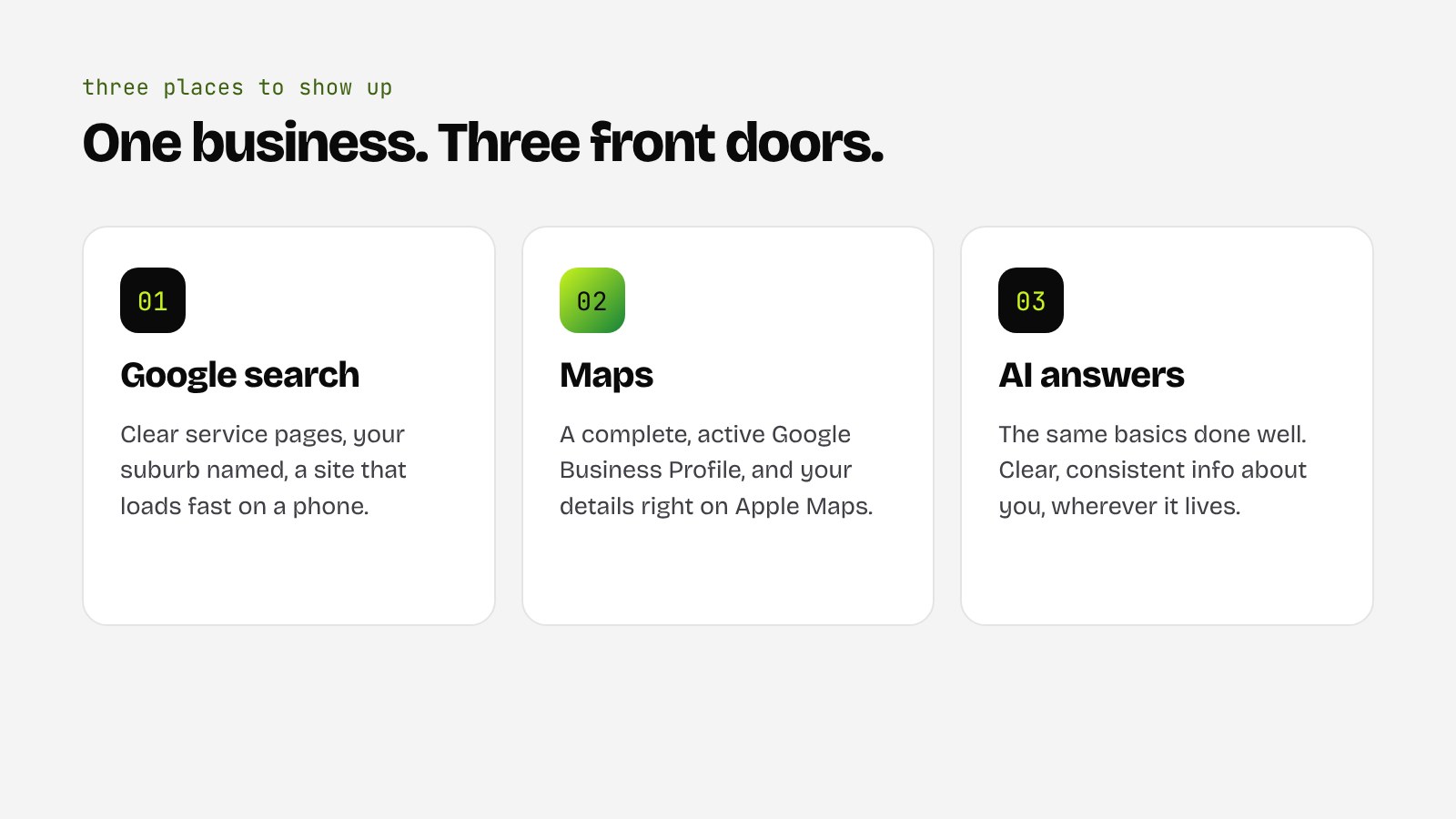
For most local businesses, Google is still the front door. Someone types "electrician Burleigh" or "best coffee near me" and gets a mix of things: a map with a handful of businesses, some regular website results, maybe ads, and often a short summary at the top.
That map section is where a lot of local decisions get made. People see your name, your star rating, your hours and a photo, and they decide whether to call before they've even seen your website.
Your Google Business Profile matters more than you think
That map listing comes from your Google Business Profile. It's free to set up and manage, and it lets you show your hours, phone number, photos, services and updates.
Google says local results are mainly based on three things:
- Relevance. How well your listing matches what someone searched for.
- Distance. How close you are to the person searching.
- Prominence. How well known you are, which includes things like your reviews and links to your business from around the web.
You can't do much about distance (short of moving the shop). But relevance and prominence are very much in your hands. Google's own advice is refreshingly plain: verify your business, keep your details complete and current, add photos, and respond to reviews. Google also says there's no way to pay for a better spot in local rankings. So if someone offers to "guarantee" you the top spot on Maps, keep your wallet in your pocket.
Don't forget Apple Maps
Plenty of iPhone owners ask Siri or open Apple Maps instead. Apple has a free tool called Apple Business Connect that lets you claim your listing and update your details, photos and logo. It takes a little while to set up, and it's worth doing once so your hours aren't wrong on half your customers' phones.
Then there's AI search
Here's the newer bit. Google now shows AI Overviews for some searches in Australia (they rolled out here in late 2024). These are short written summaries at the top of the results, with links to the websites they drew from. And some people now skip the search box and ask tools like ChatGPT instead, which can search the web and shows links to its sources.
It sounds like a whole new world, but the good news is the fundamentals haven't changed much. Google says there's no special trick or extra setup needed to appear in its AI features. The same basics apply: a website Google can read, useful content in plain text, and an up-to-date Business Profile.
In our experience, the businesses that turn up well in AI answers are the same ones that turn up well everywhere else. They say clearly what they do, where they do it and who it's for.
What actually helps
You don't need a 40-page strategy. Start here.
- Claim and complete your Google Business Profile. Right category, accurate hours (including public holidays), real photos, a proper description of your services.
- Ask happy customers for reviews. And reply to them, the good and the grumpy. A thoughtful reply to a bad review often does more for you than five extra stars.
- Make your website say the obvious things. What you do, the areas you cover, how to contact you, and your prices or a rough idea of them if you can. You'd be surprised how many sites make you hunt for a phone number.
- Give each main service its own page. A trades business with one page called "Services" is harder to find than one with a page for each thing it does.
- Keep your details the same everywhere. Name, address and phone number should match across your website, Google, Apple Maps, Facebook and any directories.
- Answer the questions people really ask. If customers keep asking whether you do weekends or how long a job takes, put the answer on your site. That's helpful for people and for search, AI or otherwise.
- Make sure it works on a phone. A lot of people searching for a local business are on their phone, often in a hurry.
What not to stress about
You don't need to chase every new platform or rewrite your site every time a headline says search is changing. Search will keep changing. A clear, honest, well-built website and a looked-after Business Profile have been good advice for years, and they still are.
- Most customers still find local businesses through Google search and maps, then check reviews before they call.
- Your free Google Business Profile is often the first thing people see, so keep it complete and current.
- AI search is part of how people look now, and the same basics help you show up there.
- Say clearly what you do, where, and for whom, on your website and everywhere else.
If you're not sure how you're showing up, book a 15-minute call and we'll have a look together.


