

Here's a little secret from the design side of the table: most projects that go sideways don't go wrong in the design. They go wrong in the brief. Someone says "make it modern and clean", the designer hears something slightly different, and three rounds later everyone's tired and nobody's happy.
The good news is a decent brief doesn't take long to write, and you don't need to know any design language. You just need to tell us what you know about your business, your customers and what you want to happen. We'll handle the rest.
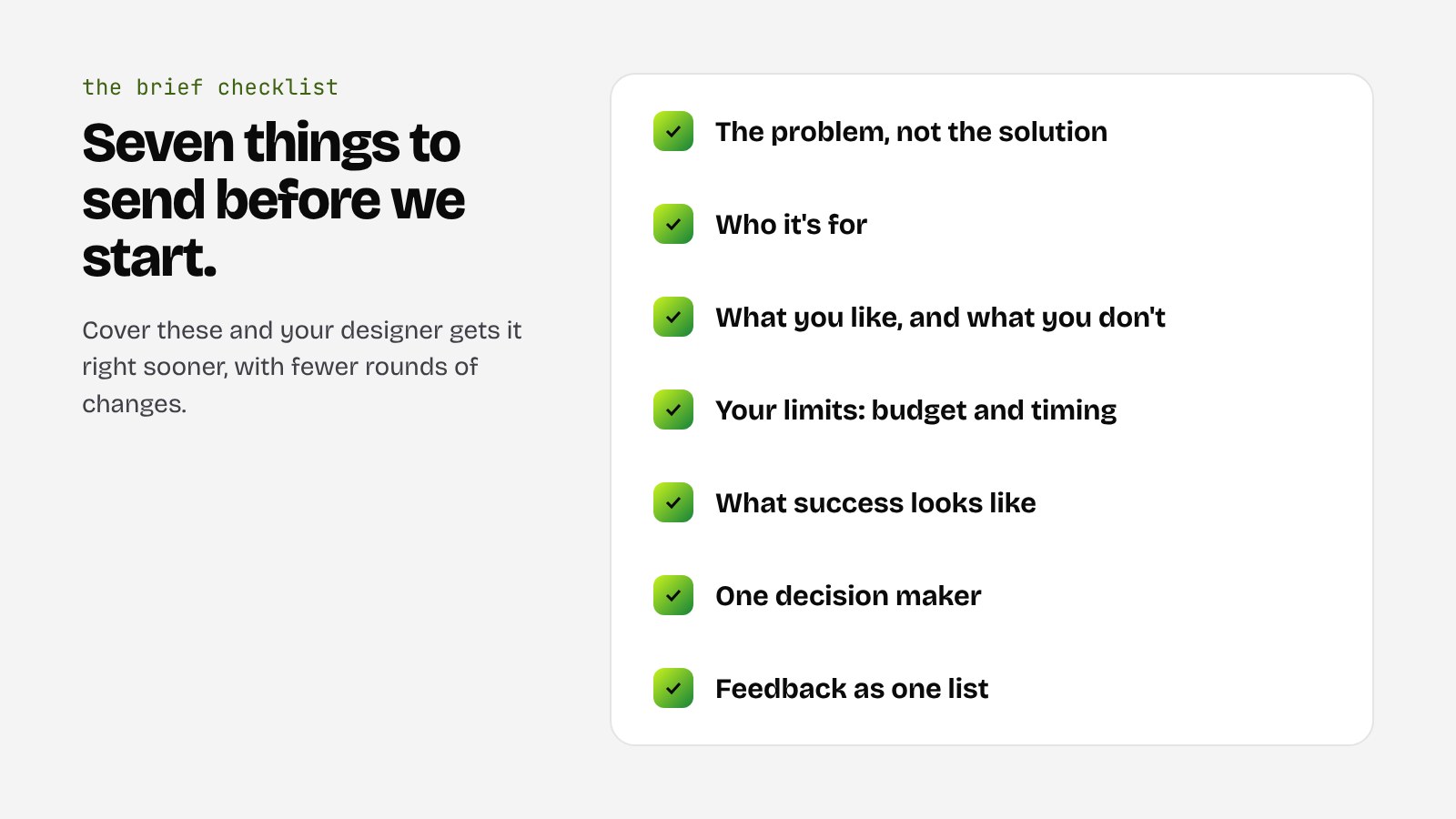
Start with the problem, not the solution
"I need a new logo" is a solution. The useful bit is why. Maybe your current logo looks homemade next to your competitors. Maybe you've expanded from one service to three and the old name no longer fits. Maybe it just doesn't print well on uniforms.
When you tell a designer the problem, they can work out the best fix, and sometimes it's not what you expected. A website that "needs a redesign" might really need clearer copy and a better contact form. Starting with the problem gives you a better result and, now and then, a smaller bill.
Tell us who it's for
Your customers are the real audience here, not you and not us. The more we know about them, the better our choices will be.
Useful things to share:
- Who buys from you now (age range, location, what they do)
- Who you'd like to attract more of
- What they care about when choosing a business like yours
- Where they'll see the work (on a phone, on a shelf, on a van, at a trade show)
A skincare brand selling to busy mums needs a very different feel to one selling to luxury day spas, even if the products are similar.
Share what you like, and what you don't
Words like "modern", "bold" or "fun" mean different things to different people. Examples beat adjectives every time.
Collect a handful of things you like. They don't have to be from your industry. A wine label, a café menu, a car ad, a website you keep coming back to. Then tell us what you like about each one. Is it the colours? The amount of white space? The tone of the writing?
Just as useful: show us what you don't like. Knowing you can't stand script fonts or anything orange saves everyone a round of changes.
Be honest about your limits
Every project has some constraints, and the earlier we know about them, the better:
- Timing. Is there a launch, an event or a trade show this needs to be ready for?
- Must-haves. Existing colours you want to keep, a logo that can't change, a platform you're already locked into.
- Practical stuff. Print sizes, packaging materials, who'll update the website once it's live.
- Budget. We know it feels awkward, but a rough idea helps us suggest the right scope rather than designing something you can't use.
Tell us what success looks like
How will you know this project worked? More enquiries through the website? A product that finally gets picked up by stockists? A brand you're not embarrassed to hand out on a business card?
Having a clear goal gives everyone something to measure ideas against. When we're choosing between two options, "which one gets more people to book?" is a much better question than "which one do we like more?"
Pick one decision maker
Design by committee is where good ideas go to die. Feedback from your partner, your business coach, your sister-in-law and your accountant will pull in different directions, and the work ends up trying to please everyone.
By all means ask for opinions. But choose one person who gathers the feedback, makes the call and talks to the designer. It keeps things moving and the result stays focused.
Give feedback as one list
When the first designs come back, take a bit of time with them. Sleep on it if you can. Then send your thoughts as one consolidated list, rather than a trickle of emails and texts over a week.
That's exactly why our projects include two rounds of changes, each sent as one list. It keeps feedback clear, stops contradictions creeping in, and means we can make all the changes properly in one go. Good feedback also explains the why. "The blue feels too cold for a bakery" is far more useful than "change the blue."
How we make this easier
You don't have to write all this from scratch. When you work with us, the Plan stage starts with a short questionnaire we call the Project Backgrounder. It walks you through the questions above in plain English, so nothing important gets missed. Once it's back, we send you a fixed price and scope within two business days. No guessing, no surprises halfway through.
- Explain the problem you're solving, not just the thing you want made.
- Tell us who your customers are and show examples of what you like (and don't).
- Share your deadlines, must-haves and success measures up front.
- Choose one decision maker and send feedback as one clear list.
If you've got a project in mind and aren't sure where to start, get in touch or book a 15-min call. We're happy to help you figure it out.


